The DisCo Death Spiral: Escaping the Nigerian Liquidity Trap
Why NERC show-cause orders trigger immediate grid throttling by the Transmission Company of Nigeria, and the exact islanding architectures Deal Desks must mandate to survive the DisCo liquidity squeeze.
The Market Anchor
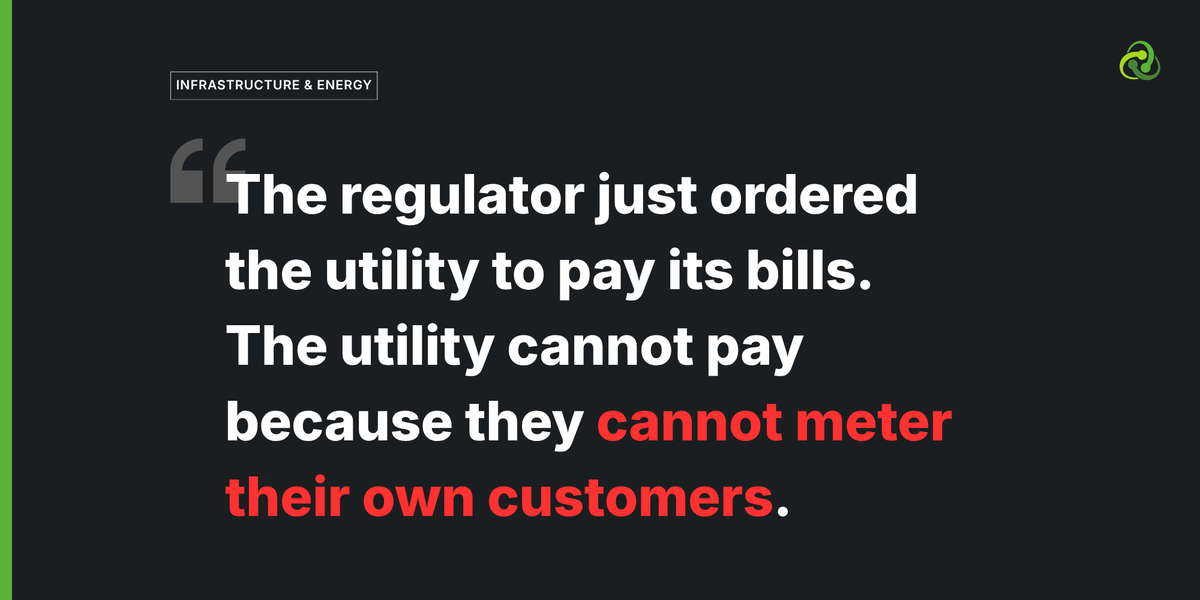
On February 8, 2026, the Nigerian Electricity Regulatory Commission (NERC) issued formal show-cause orders to two major Distribution Companies (DisCos) for failing to meet their minimum remittance thresholds to the market operator.
The public narrative framed this as a long-overdue regulatory crackdown on utility inefficiency. The forensic financial reality is that NERC just publicly confirmed a systemic utility death spiral.
The DisCos are trapped in a terminal liquidity squeeze. Because massive segments of their residential and commercial customer base remain unmetered, the DisCos rely on estimated billing, which yields catastrophic collection losses. They simply do not have the cash flow to remit their required minimums to the Transmission Company of Nigeria (TCN).
When DisCos fail to pay, TCN retaliates by structurally throttling grid delivery to those specific franchise areas. Less power delivered means even less revenue collected by the DisCo the following month.
The Multidisciplinary Blast Radius
This is not an administrative dispute; it is a localized grid collapse. If your commercial off-taker operates within a penalized DisCo franchise area, their grid availability is about to violently drop. You cannot underwrite private infrastructure assuming the sovereign grid will stabilize.
- The C&I Off-Taker Risk: If you are a heavy manufacturer relying on the DisCo for baseload, TCN grid throttling means you will be forced to run expensive diesel generators for 18 hours a day. Your operational expenditures (OPEX) will shatter your quarterly projections.
- The IPP and Developer Risk: Developers modeling grid-tied solar savings for Nigerian commercial clients assume the grid is available to hybridize with. If the grid is throttled to near-zero, your solar asset cannot synchronize, and you become the sole source of power, forcing unbudgeted deep-cycling on your battery assets.
- The Lender Risk: Infrastructure debt sized on the assumption of a blended "Grid + Solar" tariff is mathematically exposed. If the grid disappears due to TCN retaliation, the off-taker's blended energy cost spikes, triggering potential PPA defaults as they bleed cash on diesel.
Paperwork doesn't wheel power. Physics does.
The free brief ends here. Upgrade to unlock the exact contractual parameters, network capacity allocations, and curtailment mitigation frameworks required to protect your capital stack.
UNLOCK THE SOLUTIONS PLAYBOOK (KES 5,000/MO)