The Take-or-Pay Illusion: Surviving Senelec's Curtailment Strike
Why Senelec weaponized a grid emergency to enforce uncompensated midday generation caps on the Kahone solar facility, and the exact Deemed Generation covenants Deal Desks must mandate to survive the Take-or-Pay illusion.
The Market Anchor
On April 5, 2026, the Senegalese national system operator Senelec enforced a severe sequence of non-compensated midday generation caps at the massive Kahone solar facility.
The public was entirely unaware. The Deal Desks financing West African solar pipelines were completely paralyzed.
April 5 was a low-load holiday weekend. The national grid experienced a massive spike in brilliant midday solar irradiance while commercial factory demand simultaneously plummeted. This created acute low-load frequency inflation. To stabilize the network, Senelec needed to rapidly ramp down power generation.
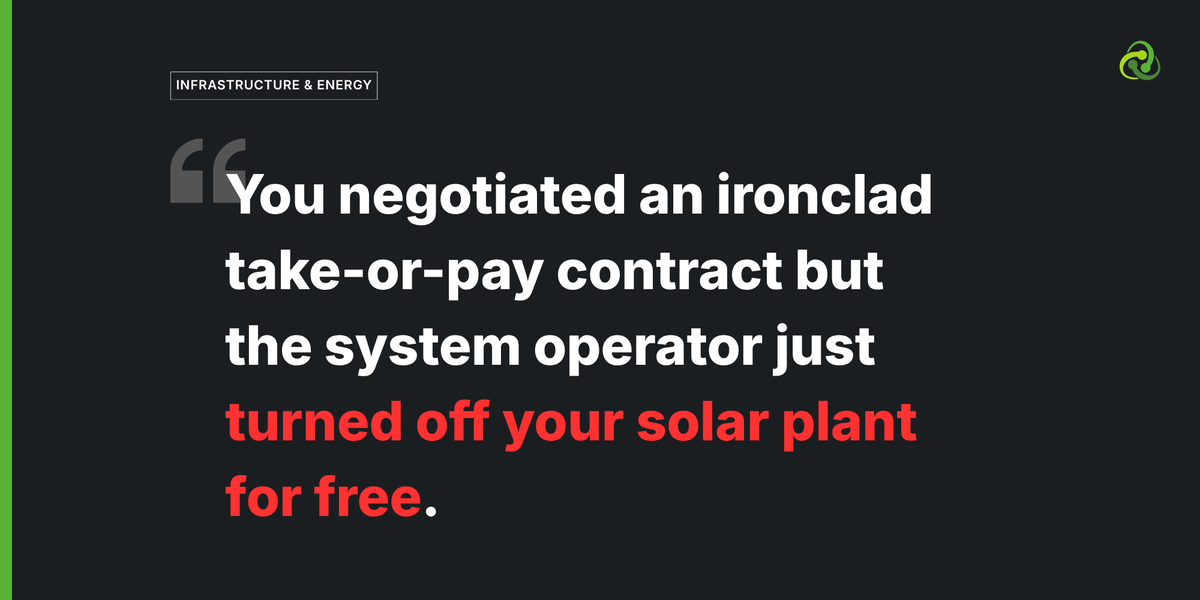
But Senelec lacks fast-acting automated thermal controls. They were physically incapable of quickly throttling down their aging baseload heavy fuel oil generators. Instead of touching their own sovereign assets, the system operator took the easiest digital route. They legally ordered the private Kahone solar plant to drop its load and spill its megawatts into the dirt.
Because the utility classified this as a "grid emergency," the Independent Power Producer was forced to swallow the generation loss entirely without financial compensation.
The Multidisciplinary Blast Radius
A 20-year Power Purchase Agreement built on a standard "as-available" energy-only structure is a financial trap on an inflexible grid. If the sovereign utility holds a legal loophole to reject your power without paying for it, your projected yield is a mathematical fiction.
- The IPP and Developer Risk: Developers model their P50 yield assuming the grid will act as an infinite sponge for their midday electrons. When Senelec caps your generation, your active power output drops to zero, but your debt amortization schedule remains rigid. You are actively bleeding operational cash while your hardware sits idle in the sun.
- The Lender Risk: The Debt Service Coverage Ratio is underwritten against guaranteed volumetric delivery. A "Take-or-Pay" clause is useless if the contract contains broad, undefined force majeure or grid stability carve-outs. If the utility can legally execute uncompensated midday generation caps, your infrastructure debt is fundamentally unsecured.
- The EPC Risk: Central inverters are not designed to be violently and repeatedly clipped from 100 percent output down to 20 percent output. Aggressive digital curtailment commands induce severe thermal and mechanical stress on the localized switchgear and inverter power modules, accelerating hardware fatigue.
Paperwork doesn't wheel power. Physics does.
The free brief ends here. Upgrade to unlock the exact contractual parameters, network capacity allocations, and curtailment mitigation frameworks required to protect your capital stack.
UNLOCK THE SOLUTIONS PLAYBOOK (KES 5,000/MO)